

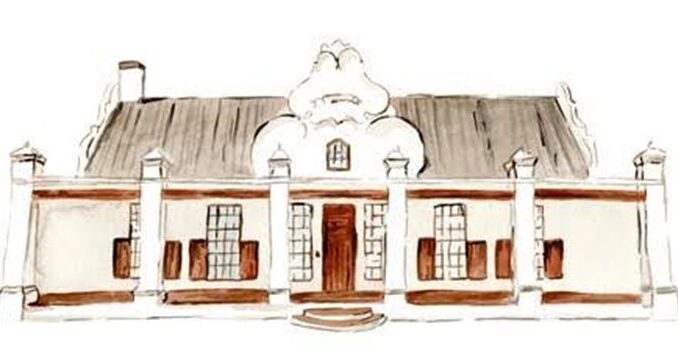
You have seen them thousands of times. That particular combination of brilliant white walls, dark thatch roof and a curved or scrolled gable above the front door, elegant, simple, unmistakable. It is as much a part of the Helderberg landscape as the mountain itself. But have you ever wondered why it looks that way?
The answer, as with so many things in this part of the world, is a story of adaptation. People arrived from one place, brought what they knew and found that almost nothing quite worked the way it did back home. So they improvised. And what they improvised, over about a century of trial and error, became something entirely new, a building style found nowhere else on earth.
The early Cape Dutch buildings were simple thatched-roof, whitewashed farmhouses. Generally rectangular, with a wooden frame, wattle and clay walls and shuttered windows symmetrically placed either side of the central front door. The floors were made of mud or dung inset with peach pits and polished to a shine.
Read that again. Floors of dung and peach pits, polished to a shine. These were not wealthy people building grand estates. These were practical people, in a new country, using what they had.
Wood was scarce at the Cape. There were no great forests and what timber existed was protected by the VOC. The walls were made of clay that weathered badly, so they were overlaid with lime plaster made from sea shells mixed with water, fat and salt and whitewashed annually, usually at Christmas. The walls were built two bricks deep to keep out both summer heat and winter damp. Roofs were thatched with dried wild reeds, restio, the same fynbos plant that covered the mountain slopes above the farm. The mountain was not just scenery. It was a building material.
Early Dutch settlers brought their architectural fashions from the Netherlands ornate gables and steep roofs and adapted them to the Cape climate. Thick whitewashed walls helped keep interiors cool in summer. Small-paned shuttered windows controlled heat and light. Deep thatched roofs insulated homes against both summer sun and winter evenings.
The gable, that distinctive curved or scrolled decorative element above the front door, began as something entirely practical. Gables evolved from simple firebreaks, designed to protect the thatch from sparks, into decorative statements, often displaying dates, initials or family crests. As farmers became wealthier, the gable became a canvas. This is where we get the beautiful sculpted gables of Vergelegen, of Morgenster, of Lourensford, each one a family’s way of saying, in plaster and lime: we are here, we have arrived, this is ours.
Cape Dutch architecture was brought to South Africa by Dutch settlers and infused with influences from German and French Huguenot immigrants. The Huguenots brought the French sense of proportion and ornament. The Dutch brought the gabled roofline from the canal houses of Amsterdam. The Cape brought the whitewash, the thatch, the thick walls, the peach pit floors. It was a genuinely collaborative invention, an architecture assembled from fragments of three European cultures, filtered through African conditions and made into something new.
Drive the R44 through Somerset West and Stellenbosch today. Look left and right. The homesteads at Vergelegen, Lourensford, Morgenster, Vergenoegd, they are not just beautiful buildings. They are documents. They tell you exactly who built this place, where they came from and what they were trying to say about themselves when the plaster was still wet and the thatch was fresh and the new country was just beginning.
Between You and Me:
Floors of dried dung and peach pits, polished to a shine. I have read that sentence many times and I am still not entirely sure whether to be impressed. The answer is well done. The early Cape settlers were working with what the country gave them and the country gave them very little that was familiar. What they produced from that scarcity, the white walls, the sculpted gables, the deep thatch, is genuinely beautiful. It is the kind of beauty that only comes from necessity. Nobody designs a peach pit floor because they have too many options. They design it because they have almost none and then they polish it until it shines.
Historian – Harmen Bockelenberg
Next week: the oldest crime in the world — slavery’s deep history and how it came to shape every farm, every homestead and every oak-lined avenue in the Helderberg.

Be the first to comment