

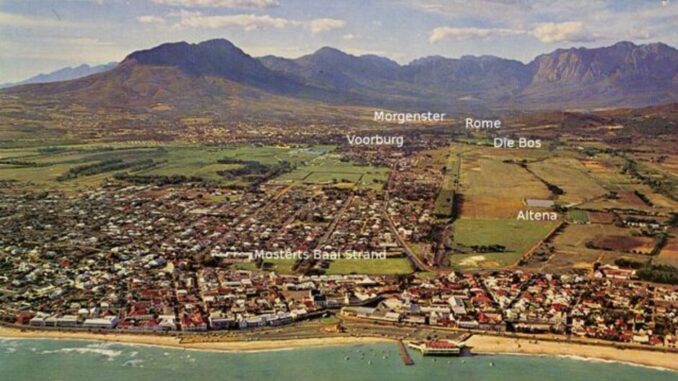
His name was David du Buisson and he was the first person to put down roots in the place you now call The Strand.
He was a Huguenot, French Protestant stock, the kind of man who had fled one world and was busy building another on the far side of the globe, born around 1680 in La Rochelle, France. He arrived at the Cape between 1700 and 1703. Before he became a farmer, he had been a tutor at Drakenstein, teaching the children of Pierre Joubert, another Huguenot. Pierre Joubert. That name again. It turns up everywhere in the early history of the Helderberg. His children needed schoolmasters and tutors, his family intermarried with everyone and his descendants eventually got their name onto streets across the entire region. More on that shortly.
In this period, a household steward, the huismeester, was responsible for managing a household and its affairs and the terms of employment were not greatly different from those of other servants: eight to fourteen guilders per month, one to two pounds of tobacco, food, drink, good accommodation and sometimes clothing at the end of the year. Some offered their services without pay, requiring only food, drink and accommodation from their employers.
One might have expected David du Buisson to support Adam Tas’s petition, for he was closely acquainted with several of its leading supporters. When his eldest son, Ferdinandus, was baptised in 1708, the witnesses included Ferdinand Appel, one of the petition’s signatories and Elizabeth van Brakel, the wife of Adam Tas himself.
In 1716, David’s father-in-law, Pierre Lombard, passed away. Pierre was the progenitor of the Lombard family in South Africa. Having fled religious persecution in France with his wife, Marie Couteau, the couple sought refuge in the Netherlands, where they suffered the loss of their first-born child. On 5 January 1688 they sailed from Texel aboard the Borssenburg, arriving at Table Bay on 12 May 1688. Contemporary records describe Pierre as “a sick man with a wife and one child.” Their daughter Claudine, who later married David du Buisson, was probably their third eldest child.
In August 1707, David du Buisson married Claudina Lombard, daughter of Pierre Lombard and Marie Couteau, both Huguenots. The surname Lombard originally denoted a person from Lombardy in northern Italy. Claudina, however, had been born at the Cape and was seventeen years old when she married David. She belonged to a new generation, French in ancestry but African in birth, a pattern increasingly common among Huguenot families and one that was helping to shape a distinct Cape community.
The farm that became their home was called Vlooibaai (or Vlooitjiesbaai). It stretched from the Lourens River in the north to the farm of Philip Morkel called Onverwacht in the east and to the sea itself in the south. Stand on the beach at The Strand today, look north toward the Lourens River mouth and you are standing on the edge of what was once David du Buisson’s farm. The white sand, the mountain at your back, the wide open sea in front of you. He saw exactly what you are seeing. More than three hundred years ago.
Life on the frontier was not gentle. On 9 May 1717, it was recorded in the Company Journal that “the farmer, David du Buisson, living in the Hottentots Holland” had been attacked in his house by fugitive slaves. The family managed to escape with their lives, but not before he received seven or eight severe wounds. Food, ammunition and firearms were stolen and the house was plundered.
In the early Cape Colony, enslaved people who ran away had nowhere safe to go, the mountains, the forests, desperate measures. That night at Vlooibaai was a collision between two sets of desperate people at the edge of the known world.
A year later, on 1 April 1718, his mother-in-law, Marie Couteau, passed away.
David du Buisson died in 1722 at approximately forty-two years of age and the farm was transferred to his widow. Their youngest son, Daniel, had been baptised only four years earlier in 1718, meaning Claudina was still caring for very young children when David died. Widowed at about thirty-two, she was left alone with the farm, several young children to raise and the sea on the frontier. Surviving documents speak of real financial hardship in the aftermath of his death. In 1722 a petition by Claudina requested that the loan farm Vlootjiesbaai be granted to her because her husband’s death had left the family in difficult circumstances. She managed it.
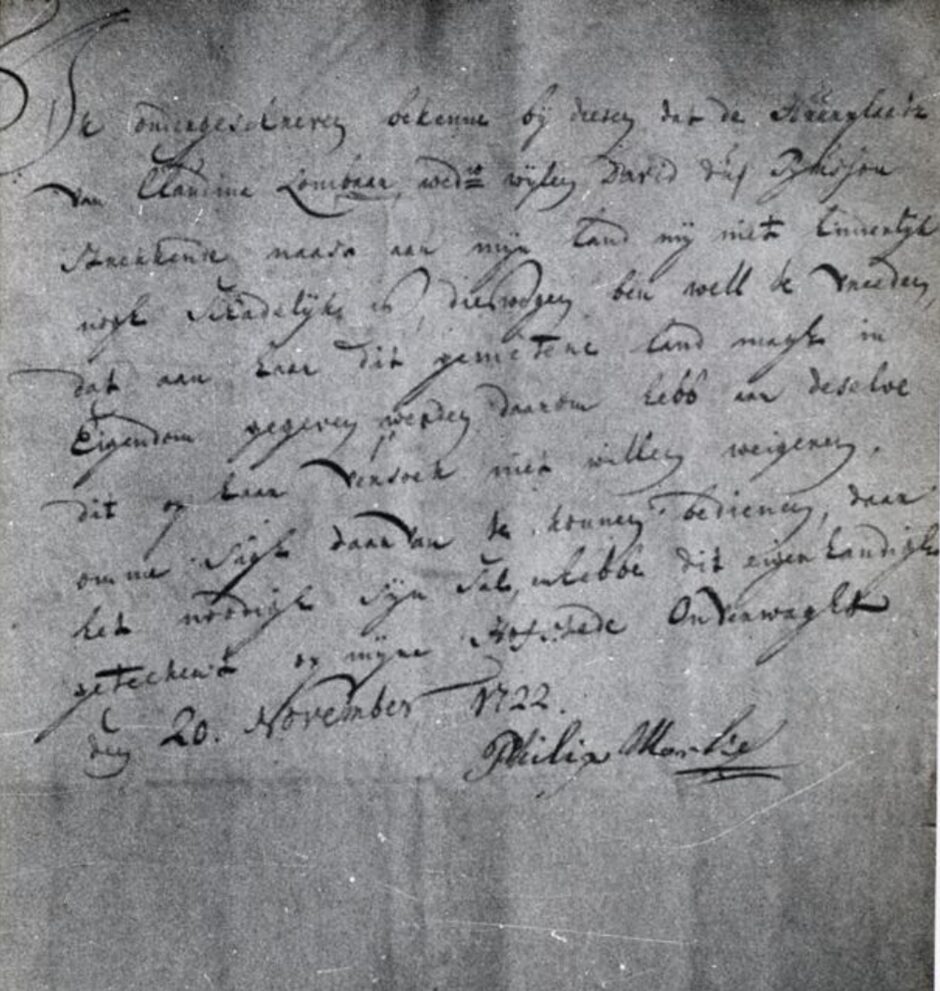
20 November 1722 – The signed letter of Philip Morkel given to Claudina
Perhaps the attack in 1717 and the unforgiving sands of Vlooibaai had broken David’s resolve, for on 28 May 1719 he leased Vlooibaai to Jurgen Radyn for a period of five years. It does not appear that he had prospered greatly as a farmer. According to the tax returns of 1719, he owned, if owned is even the right word for so modest an inventory, a wife, three sons (their eldest son having died in infancy), one daughter, a horse, twenty cattle, a musket and a sword and was still resident in the Stellenbosch district. Shortly thereafter, the family moved to Franschhoek.
It was here that David du Buisson died in poverty. According to his estate inventory, compiled on 3 December 1722 at the request of Claudine in the deceased’s home, he left behind:
Nine head of cattle, large and small; an old wagon; an old plough; a pot and a pan; three pewter bowls; six spoons; three table plates; one bucket; two chests; an old feather mattress; two casks of wine; and wages owed by Jeanne Mille; the entire estate being valued at 152 Rijksdaalders.
Jean Gardiol, Josia Joubert andré Huibeaux and François Louis Migault signed the inventory as witnesses in Franschhoek.
Following David’s death, Claudine and her children found themselves in severe financial difficulty. They could not remain in Franschhoek and both of her parents were already deceased. A petition recorded in Leibbrandt’s Precis of Requests (p. 665, dated 1722) states:
“His death has left this widow and her four children in sorrowful circumstances and therefore she asks that the place may be given to her in freehold.”
David had held the loan farm, Vlooibaai, for eight years, had built improvements upon it and had faithfully paid the annual rent. The authorities consequently granted the property to Claudine.
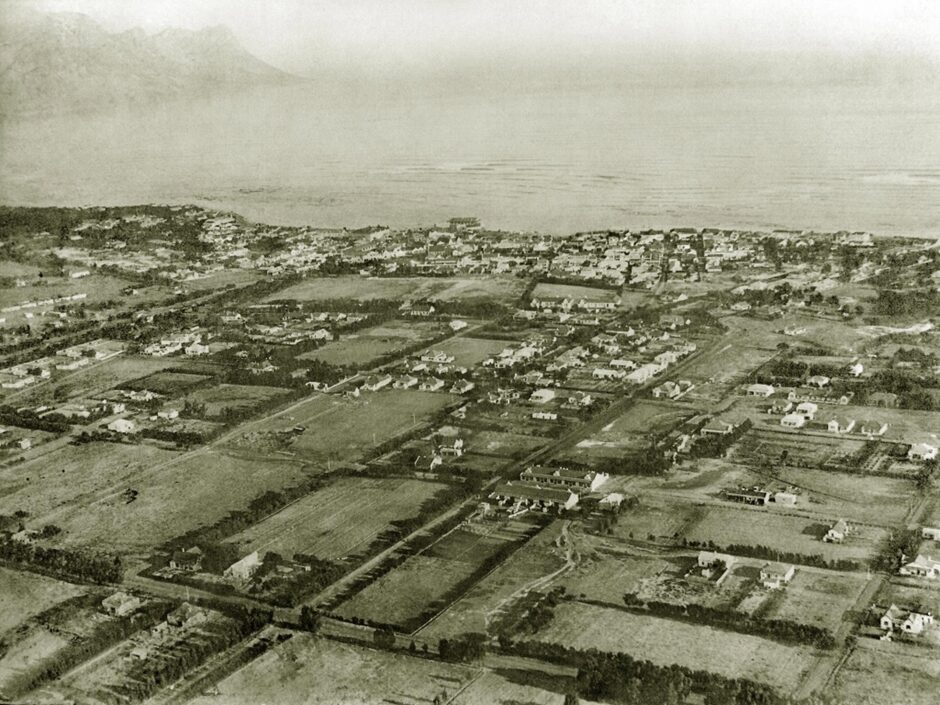
Strand, Western Cape, 1928
On 20 September 1722, Philip Morkel, a neighbour from the farm Onverwacht, signed a document declaring that the loan farm Vlootjesbaai caused him neither inconvenience nor harm and that he therefore had no objection to its being granted to the widow du Buisson as freehold property. Vlootjesbaai was bounded by the Lourens River to the north, the farm Onverwacht to the east and the sea to the south.
Fortune, however, would eventually smile upon Claudine. In 1728 she married Gerrit van Hoeting, a prosperous farmer who owned the farms Arnhem and Nimwegen on the Klein Berg River near present-day Gouda. On 24 November 1728, Arnhem and another farm, probably Nimwegen, were formally transferred into Van Hoeting’s name.
When Claudine died in 1748, she was a woman of considerable means, a remarkable contrast to the destitution that followed David’s death twenty-six years earlier. The difference is vividly illustrated by comparing her extensive nine-page estate inventory with the meagre list drawn up after David’s death in 1722.
At the time of her death, she was living at Languedoc in a substantial homestead consisting of a private inner room, rooms on both the right and left sides of the house, a kitchen, reception room, cellar, mill house and wagon house. The inventory also recorded three ox wagons, two horses and thirty-nine head of cattle on the property.
Claudine’s life mirrored the fortunes of many early Cape settlers. Widowed at about thirty-two years of age and left with four young children and little more than a handful of livestock and household possessions, she endured years of hardship. Yet through perseverance, land ownership and a second marriage, she rose from near poverty to become one of the more prosperous women of her community, a testament to the resilience that characterised many of the Cape’s early Huguenot families.
The area sat largely undeveloped as farmland for another century. As early as 1829 there was a house of sorts at Mosterd’s Bay, when half the buildings of a strand house were included in a farm sale. But the town that David du Buisson’s farm would eventually become, the five kilometres of white sand, the holiday apartments, the beachfront promenade, was still a long way off.
In later years, Vlootjesbaai was purchased by Olof de Wet. In 1748 it was acquired by Philip Morkel’s widow, who bequeathed it, together with Onverwacht and Voorburg, to her son Willem.
David du Buisson just planted the first seed. As Huguenots tended to do.
Between You and Me:
David du Buisson arrived at the Cape sometime between 1700 and 1703, taught other people’s children, married a Cape-born girl of seventeen, farmed a stretch of beach that nobody else wanted, got attacked in his own house, leased the farm out in apparent defeat, moved to Franschhoek and died at forty-two with a pot, a pan and two casks of wine to his name. His widow then proceeded to outlive him by twenty-six years, acquire freehold title to the farm, remarry a prosperous farmer and die a woman of considerable means. Remarkable endurance in this story.
Historian – Harmen Bockelenberg
Next week: the Huguenot names that survived everything — why you cannot drive through Somerset West without passing a ghost of the refugee ships.

Be the first to comment