

Imagine you are a French Protestant farmer in 1685. Your family has been in France for generations. You speak French, you think in French, your faith is woven into your identity. And then, one October morning, the king signs a piece of paper and your entire world collapses.
On 18 October 1685, Louis XIV of France issued the Edict of Fontainebleau, formally revoking the Edict of Nantes. Protestant services were banned. Churches were destroyed. Pastors were given a fortnight to convert or flee into exile. Children were taken from Protestant homes. Outdoor worship became punishable by death.
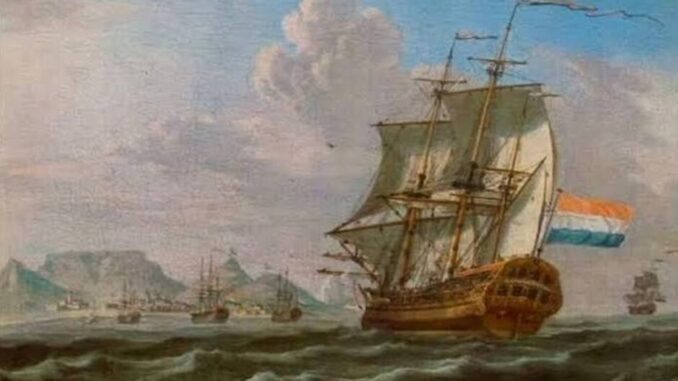
The mass exodus that followed is estimated at around 200,000 individuals, skilled professionals, merchants, farmers and artisans who scattered across Protestant Europe and beyond. Some went to England. Some to Prussia. Some to the Netherlands. And a small but significant number, 178 families in total, travelling on four ships between 1688 and 1691 ended up at the southern tip of Africa, at a small Dutch colony clinging to the edge of the Cape of Good Hope.
They were the Huguenots. And the Western Cape has never been the same since.
They arrived with almost nothing, the clothes on their backs, their faith, their skills and in many cases the specific knowledge of viticulture that would transform the Cape wine industry within a generation. They were skilled farmers who brought the fine art of winemaking to the Cape, a small group of French people who left a lasting impression on the young colony and helped establish what would become one of the world’s great wine regions.
Governor Simon van der Stel settled most of them in the Berg River valley, Drakenstein and the area that would become Franschhoek. The Huguenots found a dead-end valley called Olifantshoek, Elephant’s Corner, named for the large herds of elephants that frequented it and are believed to have used it as a calving area and asked Van der Stel if they could have it. In 1694 nine farms were allocated to the French settlers and the valley was renamed Franschhoek — French Corner.
An interesting footnote: the Berg River was originally called the Olifants River by early Dutch explorers because of the many elephants seen along its banks. There is an elephant trail that runs from Franschhoek through to Saldanha Bay on the West Coast. The elephants, like so much else, are gone now. But their path remains.
Van der Stel had one condition. He ordered the French families to be dispersed among Dutch settlers and instructed that only Dutch be taught in schools. His stated reason: that they could learn the language and morals of the Dutch nation and be integrated with it. He did not want a French community within his Dutch colony. He wanted Frenchmen who would become Dutch.
Within two generations, the French language had almost entirely disappeared from the Cape. Company directives prohibiting French-language instruction accelerated the process and by the 1730s the language had been absorbed and the Huguenots folded into the emerging Afrikaner identity.
But the names survived. De Villiers, Le Roux, Du Plessis, Fouché, Joubert, Rossouw, drive through Somerset West today and look at the street signs, look at the wine estate names, look at the surnames of half the people you know in the Helderberg. The Huguenots lost their language. But they are everywhere you look.
Between You and Me:
The VOC told the Huguenots to stop speaking French, dispersed their families among Dutch settlers and banned French teaching in schools. Within two generations the language was gone. And yet here we are, a number of years later, turning left at the Du Toit Street intersection and parking outside the Le Roux building and buying wine from the Malherbe estate. When Jacob Naudé’s wife Susanne Taillefert died, a funeral service held in French was held in the church. Attached to the inventory of Mrs. Naudé’s estate in 1724 is a document of monies due written in French and that in connection with her funeral expenses this statement appears for the service in the church in the French language, 3 rixdollars. So, she had to pay to be buried in French. The VOC managed to suppress an entire language and failed completely to suppress the surnames. You have to admire the stubbornness of a name. It outlasts everything, the king who banned your religion, the company that banned your language, the centuries that swallowed everyone who remembered why you came here in the first place.
Historian – Harmen Bockelenberg
Next week: the first Huguenot to settle in what would become The Strand — a violent night on a frontier farm and the widow who refused to lose everything.

Be the first to comment