

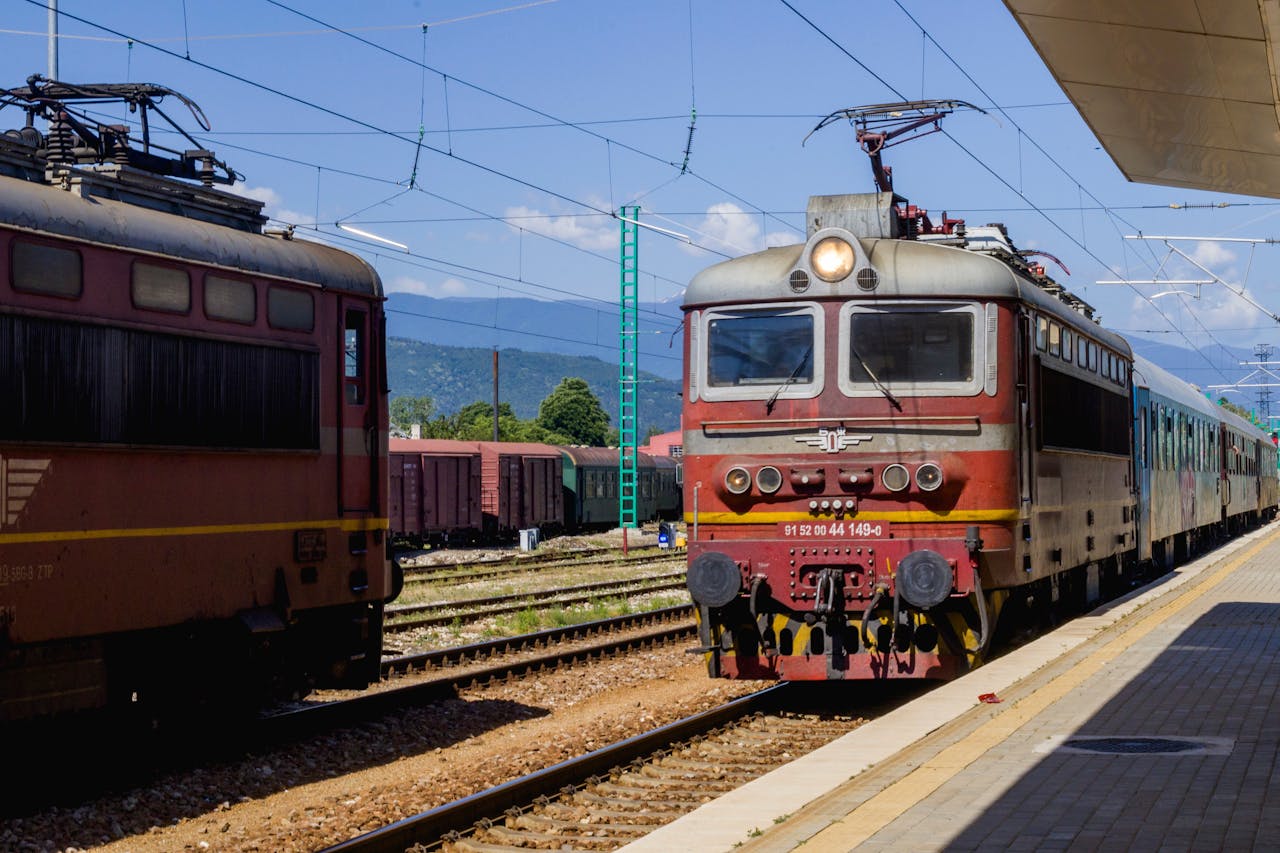
Gordon’s Bay station: built for a train that never came, converted for a car that always would.
In 1953, the people of Gordon’s Bay received a railway station. It had a platform, a waiting room, a ticket window, a station master’s office, a clock and a sign that read GORDON’S BAY in the proud serif lettering of a country that believed in the future of rail. What it did not have, (and this is the detail that separates it from all other railway stations in the history of the Cape Colony and its successors ) was a railway. The railway, it turned out, was on order. It remained on order for the better part of a decade. It was eventually cancelled. The station was later converted into a petrol station, which is the most South African possible ending to a story that began with such admirable confidence in the wrong direction.
To understand the Gordon’s Bay railway station, you must first understand Gordon’s Bay in 1950. It was a small fishing village on the eastern shore of False Bay; beautiful, remote, possessed of a harbour and a beach and a population that had, for several generations, managed perfectly well without a direct rail connection to anywhere. The road from Somerset West was adequate. The fishing was good. The harbour was active. The people were not, by any available historical record, lying awake at night thinking: what this town needs is a train.
The train was not their idea. The train was the government’s idea. The government, in 1950, had several ideas about infrastructure, most of them large, some of them correct and at least one of them, the Gordon’s Bay railway extension, belonging to a category that future historians would describe as “visionary in the original sense of the word, meaning based primarily on things that were not there.”
The plan was, on paper, coherent. The existing line from Cape Town reached Strand. Gordon’s Bay was fifteen kilometres further along the coast. A branch line would extend from Strand to Gordon’s Bay, opening the village to commuter traffic, stimulating tourism and this was the part that excited the planners most providing a link to a proposed harbour expansion that would transform Gordon’s Bay into a significant coastal freight hub. The station would be built first, as a demonstration of intent and a statement of confidence in the project’s momentum.
The station was built first. The momentum, it emerged shortly afterward, had been somewhat overstated.
I. The station: a description of something that was built with conviction
The Gordon’s Bay railway station, completed in 1953, was a handsome structure by the standards of small-branch-line stations of its era. It had a low-slung roof with wide eaves, whitewashed walls, a covered platform of approximately sixty metres (generous for a village of Gordon’s Bay’s size, but then the planners were thinking ahead, which was, in retrospect, the problem) and a stationmaster’s office equipped with a desk, a chair, a telephone connected to the South African Railways network and a framed timetable that was, at the time of the station’s completion, blank, on the grounds that the timetable could not be filled in until the trains were running and the trains could not run until the tracks were laid and the tracks had not yet been laid and this was, the planners assured anyone who asked, a temporary situation.
The clock on the platform was installed and set to the correct time. This is the detail that stays with you. Someone, a railway employee, a contractor, a man who simply believed in doing things properly regardless of context, wound the clock and set it and mounted it above the platform and it ticked, correctly and punctually, above a platform on which no train had ever arrived and from which no passenger had ever departed and to which no track led in either direction.
The clock was accurate. Everything else about the station’s operational situation was less so.
“The clock was wound and set and mounted above the platform. It told the correct time, above a platform that no train had ever visited, connected to no track, in a station that served no route. It was the most punctual building in Gordon’s Bay.”
II. The stationmaster: a man with a title and no trains
The post of Stationmaster, Gordon’s Bay, was advertised in the Government Gazette in early 1953 and filled, after a competitive selection process, by one Gerhardus Klaas Marthinus “Oubaas” Swanepoel, 44, of Wellington, who had twenty-two years of experience with South African Railways, a firm belief in punctuality, a wife named Cora and absolutely no idea what he was getting into.
Oubaas Swanepoel arrived in Gordon’s Bay in March 1953, was shown to his office, hung his uniform on the hook behind the door and sat down at his desk to await the arrival of the first train. He was still waiting when the post was quietly reclassified in 1959.
In the intervening six years, Swanepoel performed his duties with a thoroughness that the circumstances did not require but which his character apparently could not avoid. He opened the station at 6:00am every morning and closed it at 6:00pm every evening. He swept the platform. He wound the clock. He kept the waiting room clean, the ticket window polished and a supply of platform tickets available for purchase by the public, none of whom purchased any, as there was no platform activity to observe. He filed weekly reports to the South African Railways District Office in Somerset West documenting the absence of trains, the condition of the platform and any notable incidents on the premises. The reports were, by the standards of railway documentation, unusually brief. A typical entry read: “Week ending 14 August 1953. Platform: clean. Waiting room: empty. Trains: none. Incidents: a dog slept on the platform from approximately 10:00 to 14:30. Removed without incident.”
Selected Entries: Stationmaster’s Log, Gordon’s Bay Station, 1953–1958
3 April 1953: Station officially open. Waiting for first train. Platform clean. Clock correct. Cora has unpacked the kitchen. The view of the bay is exceptional. The absence of trains is noticeable but presumably temporary.
17 July 1953: Enquired with District Office re: track laying schedule. Was informed the matter is “in progress.” No further detail provided. Platform clean. A fisherman used the waiting room to shelter from rain. He did not purchase a ticket but he was polite and wiped his boots.
2 January 1954: New year. Platform clean. Clock correct. Wrote to District Office re: track schedule. Have not received reply to previous three letters. The dog has returned. I have named him Spoor.
15 March 1955: Received reply from District Office re: track schedule. Letter states the project is “under review pending revised cost estimates.” I have looked up “under review” in the Railways Administration Manual. It does not appear. I have asked Cora what it means. She said it means the train is not coming. I told her she is not qualified to make that assessment. She gave me a look. I am beginning to think she may be right.
29 October 1956: Spoor has died. Platform clean. No trains. I have been stationmaster of a station with no trains for three years and seven months. I maintain my post. It is a matter of professional pride and also of the lease on the house, which is tied to the position.
4 June 1958: Received official communication from South African Railways advising that the Gordon’s Bay branch line extension has been “indefinitely postponed pending a comprehensive review of coastal rail infrastructure requirements.” I note that “indefinitely postponed” is what “under review” becomes when five years have passed. I have been stationmaster for five years. The platform is clean. The clock is correct. There are no trains. There will be no trains. I have told Cora. She did not say I told you so. She made koeksisters instead. This is worse.
III. The track: where it went and did not go
The track for the Gordon’s Bay extension was, in the early 1950s, a matter of active planning. Survey teams walked the proposed route from Strand along the coast road. Pegs were driven into the ground at regular intervals to mark the proposed line. Engineers produced drawings. Contractors were approached, preliminary quotes obtained and at least two meetings held at which men in suits looked at maps and nodded with the confident authority of men who have not yet been asked to do anything.
The coastal route presented challenges. The cliffs between Strand and Gordon’s Bay were steep. The sea was close. The engineering required to lay track along the Clarence Drive corridor – blasting into rock, building retaining walls, managing the constant presence of the ocean was, as each successive cost estimate confirmed, considerably more expensive than the original projection, which had been prepared, sources suggest, by someone who had not visited the site and was working from a map at a scale that made the cliffs look manageable.
Each year, the cost estimate grew. Each year, the project was reviewed. Each year, the review concluded that further review was required. The pegs driven by the survey teams remained in the ground along the proposed route, slowly weathering, occasionally removed by curious residents who found them useful for other purposes, until the project was formally abandoned in 1961 and the remaining pegs were retrieved by a Railways team who drove out from Somerset West on a Tuesday, pulled them up in approximately three hours and drove back without speaking to anyone.
Oubaas Swanepoel was not informed of the retrieval. He read about the project’s cancellation in Die Burger, on a Wednesday morning, over breakfast. He finished his coffee, put on his uniform, walked to the station, swept the platform, wound the clock and opened the ticket window at 6:00am as usual. His report for that week noted: “Platform clean. Clock correct. Branch line extension officially cancelled per Die Burger, 12 April 1961. No trains. No further trains anticipated. Platform remains clean.”
“He read about the cancellation in Die Burger over breakfast. He finished his coffee, put on his uniform, swept the platform, wound the clock and opened the ticket window at 6:00am. His report noted: ‘Branch line extension officially cancelled. Platform remains clean.'”
IV. The waiting room: what people did there, in the absence of trains
A railway waiting room without trains does not remain empty. It becomes, by the logic of available space, whatever the community needs it to be. Gordon’s Bay, in the 1950s, needed several things and the waiting room of its unused station obliged with the flexibility of a building that had, by that point, nothing to lose.
It served, at various points, as a shelter during the southeaster for fishermen returning from the harbour; a venue for a monthly prayer meeting organised by the Dutch Reformed congregation while their hall was under repair; a storage facility for Bertie Eksteen’s fishing nets, which he kept there between August and October of 1955 and which Oubaas Swanepoel recorded in his log as “unauthorised but fragrant”; a polling station during the 1958 general election, at which point the Railway Administration wrote to Swanepoel to confirm that this use was “technically irregular” but that they “had no strong objection under the circumstances”; and, on one memorable Saturday in December 1956, the venue for the wedding reception of Kobus and Elna Fourie, whose families lived nearby and who had, their daughter later recalled, “always loved the station, even though or perhaps because it had never worked.”
The wedding photographs show the waiting room decorated with proteas and a hand-painted banner reading “GELUK KOBUS EN ELNA.” The platform is visible through the open door behind them, empty and correct, the clock above it showing 3:17pm, which was, by every available account, the exact time the photograph was taken. The clock was still accurate. It had been accurate for three years. It had never once been needed.
V. The conversion: from station to service station
After Swanepoel’s departure in 1959, the station was locked and left in the care of the South African Railways Property Division, which is the administrative unit responsible for assets that serve no current operational purpose but which cannot, for procedural reasons, simply be given away or demolished without a volume of paperwork that the Railways Administration found even more daunting than maintaining an empty building indefinitely.
The station sat empty for several years. The clock, no longer wound, stopped at a time that nobody recorded and that various sources have placed variously at 10:42, 11:15 and “sometime in the morning, I think.” The waiting room accumulated the quiet disorder of all abandoned spaces: blown leaves, bird life and the occasional evidence of human presence that was never explained and never investigated.
Then, in the mid-1960s, with the rise of the private motor car and the corresponding growth in demand for petrol stations along the coastal routes serving the Helderberg Basin, someone looked at the Gordon’s Bay station building; its solid construction, its good position near the road, its existing forecourt area where passengers had once, theoretically, alighted, and had an idea.
It was, everyone agreed afterward, an obvious idea. It had perhaps always been an obvious idea. The building that had been built to service the needs of travellers arriving by one form of transport would now service the needs of travellers arriving by another. The platform where passengers had waited for trains that never came would become the forecourt where motorists stopped for petrol. The ticket window would become a pay window. The waiting room would become a convenience area offering oil, spark plugs and, in later years, a limited selection of biltong and cooldrinks.
The conversion required, structurally, less than one might expect. The bones of the building were sound. The roof was good. The covered platform, a generous sixty metres of covered walkway that the planners had built for the crowds they anticipated, provided excellent shelter for cars pulling in from the coastal road. The stationmaster’s office became the workshop. The goods room became a tyre bay.
The only thing removed was the sign. GORDON’S BAY, in its proud serif lettering, came down one morning and was replaced with the red-and-white branding of a petrol company whose name, like the name of every petrol company that has occupied the site since, changed every fifteen years or so as the industry consolidated, was sold, was rebranded and changed again. The building has outlasted four petrol brands. It outlasted a railway that never arrived. It will, in all likelihood, outlast several more things yet.
VI. What the locals remember
Oom Piet Marais, 91, Gordon’s Bay: resident since birth
“I remember the station being built. I was a boy. My father said the train was coming and we would be able to go to Cape Town without the bus. I waited for the train for years. We all waited. Then one day there was petrol instead. I have bought petrol there since the 1960s. It is good petrol. But I still think about the train sometimes.”
Tannie Miems Engelbrecht, 84, Gordon’s Bay
“My sister was married in that waiting room. 1956. Beautiful wedding. The stationmaster was Swanepoel, a very neat man and he swept the platform specially. He also wound the clock that morning, which my sister said was the most romantic thing about the whole day, that this man wound the clock for her wedding even though no train was ever going to come. She kept a photo of the clock on her bedroom wall until she died. 10:24 in the morning, when they took it.”
D Joubert, 68, Somerset West, transport historian, unpublished
“The Gordon’s Bay station is actually a fascinating case study in what planners call ‘supply-side infrastructure development’… It’s when you build the facility first to stimulate the demand for the service. It can work. It didn’t work here. What it produced instead was the world’s most punctual building with no purpose and one very dedicated man who swept a platform for six years waiting for a train that the government had, by about 1955, privately accepted was never coming, but couldn’t bring itself to say out loud.”
Henk Botes, 55, Gordon’s Bay, third-generation petrol station customer
“My grandfather bought petrol there. My father bought petrol there. I buy petrol there. My son buys petrol there. None of us have ever taken a train from there. It’s a very good petrol station. Full service, which you don’t get everywhere anymore. Promise, our attendant, he’s been there twenty-two years. He knows every regular by their car. I think of him sometimes as the stationmaster. He knows when everyone is coming and what they need. It’s basically the same job.”
VII. The clock: a final note
No one knows with certainty what happened to the station clock. The South African Railways Property Division, when the building was decommissioned, did not produce a detailed inventory of removed items. Local memory is divided between those who believe it was taken by the Railways when the building was handed over, those who believe it was bought by a Gordon’s Bay resident at some kind of dispersal sale that nobody can precisely date or confirm and one persistent account told by Tannie Miems’s late brother and repeated often enough to have acquired the patina of local legend; that Oubaas Swanepoel took the clock with him when he left in 1959, wrapped it in his uniform jacket, put it in the boot of the car Cora drove while he sat in the passenger seat looking straight ahead and that it hung on the wall of his workshop in retirement until he died.